Wednesday, November 20, 2019

It's Not About the Pasta

Every night, my wife and I collectively decide what television show we're going to watch that evening. I always push for The Challenge on MTV. She always votes for anything related to The Bachelor. Together, though, we can agree on Vanderpump Rules.

For those of you not familiar with the (fake) reality show titled Vanderpump Rules, it follows Lisa Vanderpump (of Real Housewife "fame") and the late-twenties servers at one of her restaurants. Many of the main cast of characters have had intertwining relationships and the weekly fallout therein makes for great, mindless television each week. 

In a semi-recent scene (words bleeped out, be careful!), James Kennedy (a "DJ" for the restaurant who calls himself the "White Kanye") and former BFF Lala (who believes she's Tupac reincarnated) have an argument that centers around Lala eating James' girlfriend's pasta. Lala boasted about doing so and James got quite upset. They proceeded to have an argument about the pasta eating in the middle of the street with the cameras rolling. During the argument, James would scream "it's not about the pasta!" but Lala would return the conversation back to the pasta. 

It was fascinating television as they argued back and forth about the pasta incident, but as James said at the end of the clip, it truly wasn't about the pasta. It rarely is.

One thing I've discovered is that when friends, colleagues, spouses, family members argue with one another, it's rarely about the pasta.

Often, the argument is about how someone felt slighted, ignored, excluded, upset about how they were treated. Complicating matters more, the other person is rarely aware of how this person is feeling because there's little to no communication. Thus, someone will suffer in silence, building up their pain until that last little drop of frustration overflows their internal already filled-to-the-brim cup of kindness. 

Part of the problem is that we, as human beings, often shy away from hard conversations with the hope that things will get better on their own.

Newsflash: They don't.

As an educator, I've seen incredibly talented co-workers privately share how hurt they were at the actions or the words of one of their colleagues. I'll listen and always encourage them to seek out that person to discuss. Most times, the person who has hurt them isn't even aware that their words or actions were taken in such a manner. Even more so, there's a miscommunication that led to their feelings and could be easily addressed. 

What's interesting is that I've found many educators will shy away from having these conversations with their colleagues. Perhaps they think things will get better on their own. Maybe they are intimidated by the their co-worker. They might believe that nothing will change if they do bring up their concern. However, by staying silent, nothing improves and one's own mental health can suffer. And when they finally do speak up down the line about a separate incident, it's hard for their co-worker to understand why they're so upset about "the pasta". 

Given that most of these conflicts occur through miscommunications, I'd like to suggest the following for any educator struggling with a colleague:

First, when you see or hear something that upsets you, don't wait too long to respond. If someone says something flippant in the staff room at lunch, let them know right then and there that what they said wasn't nice or accurate. If a teacher says that all of the kids at your school are lazy, speak up and let them know that's (hopefully) not true. Don't let the one teacher's narrative become your story.

Second, if you hear something that a colleague said through the grapevine, try to speak with them directly. Quotes quickly lose their context when shared outside of the original conversation. Just go straight to the source and ask for a clarification. Sarcasm doesn't travel well and is often a signifiant source of colleague conflict in schools. 

Third, assume positivity. Maybe your co-worker is having a rough day, month, year. Maybe their comments are a cry for help and support. Are they a good educator, someone who you'd want your own child to be in their class? If so, perhaps assuming positivity throughout the miscommunication might help fix the minor conflict.

Fourth, don't make the issues of others your own. I believe it is good to support your peers, but there's a saying out there: These mountains you were carrying, you were only supposed to climb. If you absorb the negative emotions of others, you'll find yourself drowning in your days. Acknowledge that sometimes people will just say things they shouldn't and not always be as nice as you'd like them to be. This is ok. 

Fifth, when you do have a hard conversation with a colleague, don't argue about non-issues. Just be kindly blunt and perfectly direct at how you're feeling. Don't expect them to own your feelings, but instead hopefully acknowledge how their words and actions contributed to the conversations you're having now. The hope is to rebuild whatever bridges were broken but it takes both parties to agree to this project. 

And sixth, when you do have the conversation, be ready and willing to let your frustrations over the first incident go. If you harbor these thoughts beyond the initial chat, you haven't truly had a conversation worth having. Make sure when you have that colleague conversation, you're ready to fully clear the air so you're able to walk away anew. Otherwise, you'll just be internally upset while your colleague assumes things are perfectly fine.

Don't assume that things will just magically improve without working to address the concern. Don't wait for a second... or a third event to happen and cause the relationships to further deteriorate. When this happens, it's harder for both parties to address the original concern. After all, as the cast from Vanderpump Rules can confirm, it's not about the pasta.

Friday, June 7, 2019

Graduation Speech - 2019 - Union Middle School

Below is my graduation speech for the Union Middle School class of 2019. 

This was an odd speech to write. With everything going on at home these days with the four kids, there wasn't that organic moment I've experienced in years past that spurred the graduation speech to be born. I'm not sure why this year was different. I adore this year's class; it's filled with amazing kids. Even the kids I would see on a regular basis in the office are wonderful young adults. 

About two weeks ago, I wrote down a few bullet points about relationships. It's how I write a lot of my blogs. I take a topic, write down 3-5 main points, add in a few words/examples about each of the five points, and then fill in the details at a later date. A week later, I did just that and expanded on the bullet points, ending up with the below graduation speech. 

What I've got below is 99% of my first draft. That's another difference than past speeches: I didn't do a lot of revisions. It felt a bit odd to me as I've never written a graduation speech this way. I also didn't share the speech with my wife or my usual peer edits. I read it aloud on Wednesday to our assistant principal and that's it. My final few edits came this morning, the day of graduation. I actually started to write a different speech, a more generic one, at 8 am this morning but quickly discarded it. I'm not sure why I was fighting this speech so much.

For whatever reason, I'm glad I stuck with my original words. It's a bit shorter than some of the past diatribes, but that's okay. I'm happy to have had the opportunity to share this message with our students as they promote on to high school. They're such a great class. We are going to miss them.

As always, thank you parents for your support over the past three years, thank you staff for your continued dedication to our students, and thank you students for just being you. 

Here is the graduation speech. Enjoy.

-Todd

-----------------------------------------------------------------------------------------------------------


Good Evening Everyone,

For those of you in the audience who don’t know me, my name is Todd Feinberg, and I have been privileged to have been the principal of Union Middle School for the past seven years. As always, it is an honor to stand in front of you all today, amongst our 8th grade class and entire Union Middle School faculty. We truly care about each and every one of our Union Tigers. We hope you all will keep in touch.

To the class of 2019 - congratulations. You've (almost) made it and in a few short minutes, you'll be walking across this stage to signify your promotion from middle school and, perhaps more importantly, your official transition to high school. This is a rather important moment in your young adult lives. Enjoy it.

But first, a few words...

Given this opportunity to address the class of 2019 for one final time, I'd like to thank each and every one of you for being a part of our school campus during your middle school years. We've loved your uniqueness, your charm, your determination, and everything else that's bundled up into the class of 2019. As always, I'd like to share a little advice on the eve of your descent into all things that are high school.

While there’s many tidbits of positive affirmations I could share… such as “take risks, have fun, enjoy these days - they don’t last forever, challenge yourself in everything you do, etc etc…” Instead, I’d like to just talk about relationships and how important relationships are for you moving forward.

It’s because relationships matter. Wherever you go, whatever you do, it's the relationships you've made along the way that highlight who you'll one day become.

Your relationships with your friends matter. I encourage you to be the friend who doesn't just listen but also hears when someone's in need. Try your best to surround yourself with friends who bring you up and not down. Those you meet who thrive on negative attention aren't. truly. friends. at. all. And don't be afraid to make new friends - the person you were at age 6 in kindergarten isn't the same person you will be when you graduate high school in four years - just as you've changed, your friends, current and future, have changed as well. Remember - there is no limit to the number of friends you can have; everyone you meet has the potential to be a lifelong friend. Take advantage of these opportunities to do so.

Your relationships with trusted adults matter. Specifically, your teachers. The ones who gave you a second chance on an assignment that you know you didn't best prepare for the first time around. The ones who spent the afternoons and evenings creating lessons that they hoped would engage and inspire you and build upon your desire to learn. The ones who wrote private high school recommendations for you. The ones who chose you as their Way To Go Student or Nacho Average Student or Deserving Dessert Student. The ones who opened up their classroom for you after hours to finish a test or seek extra help on that challenging classroom assignment. The ones who spent countless hours with you and your volleyball teammates in sixth grade, trying to help perfect your left handed serve. I'm talking about the entire UMS staff who are all present today to watch you walk across the stage. I can't stress enough how important it is to build positive relationships with your teachers. I'm only here today because of a chance encounter with my sophomore high school Spanish teacher - yes, blame Mr. Garcia everyone - who encouraged me to apply for a teaching job that started me on this path. Your teachers have been and will be some of your fiercest supporters. Continue to cultivate those relationships in high school and beyond. And don’t forget to thank them along the way.

Your relationships with your family members matter. Trust me when I say this... even if you are battling your parents or guardians right now on every single logical consequence and limitation they've given you, in about twenty years time, you're going to realize just how right they were about everything that you disagreed with when you were 14. If you're shaking your head right now, saying "oh, it won't be me", then yes, it most definitely will be you. Your parents, your grandparents, that aunt you've never connected with, every family member you may have: they have a love for you that you probably won't understand until you're in their shoes, watching your child, nephew, grandchild walk across the stage at their middle school promotion. My mother in law passed away 18 months ago. Not a day goes by where my wife doesn't share that she wishes that she had just one more chance to talk to her mom. Just one phone call. One hug. Just anything to hear their voice. Students - please take a moment later to write a note to those family members who have helped you get to this point in your life. Thank them for being there for you.

And finally, perhaps most importantly, your relationship with yourself matters. I saved this one for last on purpose. Everyone is always so hard on themselves. You aren't expected to be perfect. Be nice to yourself. Give yourself a bit of grace. If you're one of those students who frequented my office during middle school, think about how our conversations have changed over the past three years and take what you've learned to build upon that success for high school. You are all such dynamic, talented young adults and we want you all to know that we're proud of you, even when the days seem darkest.

I hope you all continue to keep the relationships you've built over the past three years and grow even more moving forward. And if there's anything I can ever do to help you on your journey through life, don't hesitate to ask. Congrats on your promotion. We are all very proud of each and every one of you.


Saturday, March 16, 2019

"But We've Always Done It This Way" is Your Enemy

As a middle school principal, I'm always looking for ways to improve from what we'd doing well to what we could be doing better. We always are looking for those school practices that we've had for the longest time and brainstorm how we could be upgrade the user experience with new perspectives, a little bit of work, and a culture of yes. This past year, we looked at how we ask our students to sign up for their elective with the goal to support all students and increase the odds every student would get their first choice elective.

The elective process begins in February as we build the master schedule. A lot of work goes into the master schedule as we balance class sizes, assign prep periods, and yes, place electives during certain periods. It's important where we place electives as students sign up for a block of electives within the same period. For instance, if they want Intro to Leadership, they also have to take Minecraft as they're the only two electives that specific period.

Fast forwarding to May, we meet with our incoming 6th grade parents and share what electives they can sign up for. Meanwhile, for our current students who are returning for the upcoming school year, we have them select their elective classes during the school day.

Here's why we have our students select their electives this way:

1) We get close to a 100% response rate. When we allowed kids to have a week at home to sign up for an elective, you saw a certain trend in which students didn't sign up for an elective. These students were then dropped into a random, non-preferred elective that Fall. Having the elective selection take place during the school day levels the elective playing field for all students, regardless of the parental support at home.

2) We get instant results and can make changes over the weekend if necessary. If there's an elective that is undersubscribed, we can make the change immediately rather than waiting until weeks later. It's incredibly helpful to have this data all at once and with sufficient time left in the school year.

3) The students get to choose their elective as opposed to the elective their parents want them to have. We're in middle school. If there's every a time for a student to venture out and try something that they're not familiar with or perhaps something they have an interest in but never got the opportunity to explore. Sometimes, a student's choice is in conflict with the parent's choice. If the students get to choose, I'm hopeful they'll select what they, and not their parents, want.

We went a different route this year for our electives, using Google Forms. Aside from a few basic questions, all of the three expectations above were met.

Based on a few of the selections, we needed to make a few changes. Specifically, we needed a third year long Spanish class and more Intro to Leadership classes. We switched a semester Intro to Spanish class to the year long Spanish class we needed and added a year long Intro to Leadership class, embedded with elements from our Design Thinking elective. These are normal changes that we work through every single year; nothing out of the ordinary.

With the change, we emailed all of the students who signed up for the semester Intro to Leadership class to provide the opportunity to select instead the year long Intro to Leadership class. The following day, I shared with all of our 6th and 7th grade families that there were a few spots left in this newly-created year long Intro to Leadership class as well as our new-to-UMS year long Computer Discoveries (read: Coding) class. I strongly encouraged to speak with their student and make sure that if they wanted a spot in one of these classes, please sign up as soon as possible.

What I didn't expect to happen then did: a huge influx of students changing their electives to these two classes.

While this is a pretty cool thing, it's also rather complicating.

With a year long class, we have just 25-30 seats available for interested students. As sign ups inched up to 15... and then 20... and then 25... and then 28... for each of these electives, I realized that we were going to be oversubscribed with interested students.

So I sent a second communication twenty four hours later, sharing with our families that these electives were now "closed", based on significant student interest. We still allowed students to sign up for these electives but their selection would now show that they missed the cut-off deadline. Essentially, they'd be put on a waitlist for the class.

Some parents were not happy with the news.

One parent emailed, telling me (rather than asking) that their student needed to be in the year long Intro to Leadership class. Even when I explained the situation, providing a look behind the elective curtain, they didn't change their opinion: their student to be enrolled in the course. We went back and forth a bit, me trying to explain how the elective process works, them responding with a constant expectation of their child being placed into the elective. Even when I shared how it is an elective request, not an elective mandate, the parent seemed to be unmoved from their constant opinion regarding their student's upcoming elective.

Another parent was upset that they only had 24 hours to sign up for their student's elective. As a working parent, they shared how hard it was to get a text during the work day and follow up that evening. It was a terse conversation that prompted a follow up phone call to smooth things over. The follow up communication allowed me to point out how the year long Coding class was available to their student the previous Friday with the warning that if the year long class filled up, we wouldn't be able to proceed with the semester class. All in all, things ended up okay as their child enrolled in the class with plenty of time remaining. Usually, it just works out in the end.

And there was a third noteworthy parent who was disappointed by the "first come, first served" nature of the availability for the year long Intro to Leadership class. Truthfully, I agree with them; I'm not a huge fan of "first come, first served" procedures. With the limitations we have with only so many seats for our year long electives, it's an unfortunate predicament we're in. As we progressed through our conversation, the parent responded with the following:

"I'm sure it will be fine! My kid - who thinks a lot - is already done thinking about it. ;) I expect there's no perfect method and there will be complaints no matter what. I appreciate your responsiveness to the "small things." It gives me confidence that if I need to address a larger issue at UMS, it will be considered carefully.

Btw, one of my older kids was a student who was dismayed, at registration in August, to find he was assigned an elective he didn't want: Intro to Spanish. The teacher later told others the story of how he asked an unknown teacher, who was assisting students on registration day, about switching out of his randomly assigned Intro to Spanish class. She said, "Hi, I'm the Spanish teacher," and directed him to speak with several former students nearby, and told him he could try the class and request a change later if he wanted. He ended up loving the class..."

Overall, the change in how we ask our students to select their electives was a positive one. We definitely saw a significant reduction during the school year in students asking to switch into a new elective. Fewer elective change requests frees up our counselor and administrative team to focus on more kid-centric concerns during the first few days of the semester.

If there are past practices at your school that you've been hesitant to change, perhaps saying "but we've always done it this way," take the next few months to consider revamping your approach and consider a fresh, kid-focused shift in your policies for the upcoming year. It's not about being good enough; it's about doing our best for the kids. 


Saturday, November 3, 2018

Sharing Your Admin Story

One of the hardest things of being a principal is speaking in front of adults. Kids, no problem. They're great. Sure, they remember all of things you wish you hadn't said (and somehow they always seem to repeat these seemingly-innocuous comments years later when they visit) but overall, they're usually a sweet, easy-to-work-with audience.

Adults are a whole different story. Whether it is a weekly meeting with our teaching staff or an overflowing gym of parents at Back to School night, there's just something about speaking in front of adults that puts my nerves on high alert. I'm told that it's not noticeable and everything presents relatively normal during these speeches. Inside, however, I'm second guessing every word, worried I'm not connecting with everyone in the audience, and often will veer off-script with some silly humor that doesn't always hit the mark.

Given the struggles I regularly experience with speaking in front of adults, I find it interesting how much I enjoy sharing my admin story with other administrators at various conferences and professional development opportunities. My best guess is that I truly love the opportunity of being able to share my "admin story" with other administrators and educators.

Being an administrator is in itself a rather lonely job. Sure, you're surrounded by a thousand students, two thousand parents, a staff of a hundred hard-working adults, and other student-focused administrators at other school sites and district office. But day to day, you make decisions separately in your silo, always trying to prevent the spinning plates from falling. Each of your decisions, no matter how innocuous, gets second guessed, sometimes by an upset staff member, an irrational member of the parent community, or a supervisor at the district office. I'm blessed to have an incredibly talented staff, a very positive and kind parent community, and an extremely support district office (note: this trifecta is very rare). Still, it doesn't make a principal's day any easier: That's one fo the reasons why sharing my "admin story" with other administrators is something I look forward to.

This Fall, I presented at two conferences: CUE Admin RockStar and Fall CUE (don't say these two words too fast...). I've blogged about my initial CUE Admin RockStar experience and was pleasantly surprised to be invited back. The CUE Admin RockStar conference is for current and future school administrators. Held in Truckee in late September, I presented on Mobile Leadership and Blogging over the two days for a total of five presentations. Two days of nonstop talking. Heads nodding. Lots of thank you's. Tons of DMs thereafter of future connecting and support. It helps bring our principal worlds a little closer together when we realize that the situations we educators face are more alike than different.

The second conference, Fall CUE, was another session on my admin story, titled "Building a Better Admin: Lead by Example." Here, I shared tons of tidbits on how I support my admin life to allow for increased parent communication with our school, how the importance of relationships can drive a student's school experience, and, of course, my secrets with Google Forms, Docs, Sheets, and Sites to streamline a principal's workflow. During the presentation, I will often share topical "war stories" with the admin community in the room, whether it's a silly student story, an out-of-control parent from my last district, or just some personal notes of what it's like to have four kids. This experience doesn't feel like a presentation as much as the congregation of admins coming together to smile, learn, and exhale.

Truthfully, there's another reason I enjoy presenting at conferences: It's a compliment to be chosen. It means that someone in the edu-world values what I have to say and think it could be valuable for others. Principals don't get a lot of positive feedback; being chosen to present says we're on the right admin track.

And I'm always surprised when my sessions get selected. I don't feel like I have the secret ingredients of what it takes to be a successful principal. I'm not even sure some days, despite the positive feedback I receive from parents and fellow district educators, that I'm doing a good job. Most of the time, I'm just doing what I feel is best for our students and providing our staff whatever they need to be successful. A lot of the work that a principal does to support their school goes unnoticed. It's just part of the job.

Prior to the CUE Admin RockStar event, I was asked by the organizer to provide a morning keynote. It was suggested that I share the same keynote as the previous RockStar event where I spoke about flipping our typical Back to School night into something a bit different. This would have been the easier option. I didn't take it.

Instead, I shared my real "Admin Story" with the fellow conference-attending administrators who had given up their weekend to improve their practice. My keynote centered around my Molly and what it's like to have a child with special needs. I talked about how important it is as an administrator to support all students, especially those with special needs. I shared my thoughts on the importance of hiring nice staff members, how my wife and I do not often feel that we're not doing that great job as parents, and the likelihood that the parents of special needs students at your school are probably feeling defeated by the limited opportunities and supports their child's school provides. I discussed that one meeting where, at age 4, the school psychologist wanted to label our daughters as intellectually disabled.

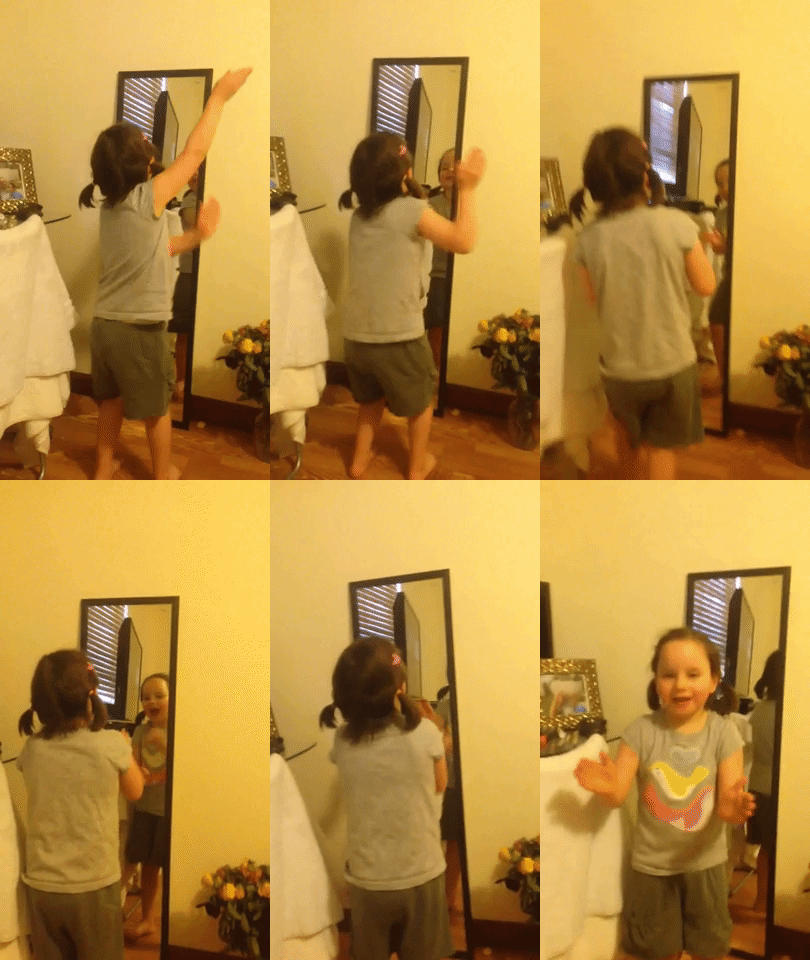
Somewhere along the way, despite how much I enjoy these admin talks, I lost the ability to speak. I rolled through a few of the slides, all pictures of my Molly. Her smile. Her first steps. Her silly dancing in front of a mirror.

I managed to close the keynote shortly thereafter, tying in an earlier thread to my daughters' plight. A fellow presenter at the conference gave me an instant hug and then publicly praised my ability to share my story.


And I think that's the job of a school administrator: pulling down your walls and sharing your story. Be upfront and honest about who you are and what you're struggling with. Our parent communities don't expect us to be perfect; they just want us to care. Sharing your story as a school administrator can help bridge these relationships toward the common goal of working together for what's best for your students. It doesn't mean it's going to be easy, especially for those administrators like myself who just don't like speaking in front of adults. But as I tell our students, the right thing to do and the hard thing to do are often the same thing to do.


Share your story.


Wednesday, September 19, 2018

Trust the Process (and the Principal)

I've blogged about Trust before. I've called it a four letter word. All of this is true.

But as we've started another school year, I've faced a constant stream of questions and inquiry from our parent community that hints at a lack of trust in the school system.

Let me preface this blog with the following: I don't blame our parent community if they are hesitant to trust their child's principal. I've blogged before about the struggles my wife and I have faced in best supporting our daughters in their school district. If you don't have trust, every action by your student's principal is put under the microscope moving forward.

Knowing that the transition to middle school is a challenge, I prepared specific slides for our 5th grade parent night. When our parents had questions thereafter, I put together a FAQ to best respond. During the summer, I shared additional information with our incoming parent community. I sent home reminders during the summer months. With our 6th grade parent orientation, I shared additional information. Over the days following this meeting, I answered more questions about the transition to middle school.

I'm not sure you'll find a middle school that shared as much information with their incoming parent community in the summer prior to the start of the school year as what we provided this past summer.

And yet, based on the continued flurry of concerns and emails from our parent community, it still doesn't feel like enough.

It doesn't feel like enough because we're still receiving questions and concerns... and most of these questions have answers that are harvested within trust.

Trust that we're going to take care of your student.
Trust that we know how to best support our students.
Trust that we're prepared for the upcoming school year.
Trust that we've ready for every event and activity your student may want to participate in.

And yes, we've received some unique (because there are no such thing as silly) questions as well...

Yes, we have WiFi in our homework center (how else would they be able to do their homework?)
Yes, students are allowed to have backpacks during the school day (ok, was this a real question?)
Yes, we have campus maps (on the website and also available in the office)
Yes, we have clubs your student can participate in (and you'll receive information at a later date)
Yes, you're allowed to walk your student to school each morning (it's also ok to let them walk the five blocks on their own).

In the end, all of these questions come down to trust.

I remind our parent community that I've been at UMS for the past 8 years and have a very experienced and talented front office staff - we know what we're doing.

I share that our teaching staff is dialed in times ten and know how to best support your student - this is the best middle school staff anywhere.

I spend my summer, often at the expense of family time, making sure that your student has the best schedule possible for their 6th grade experience - we literally hand schedule every single student, spending more time perfecting our master schedule than what you'll find at any other middle school.

And I overshare as much as possible with everything our parent community needs to know for their 6th grade year - all in an effort to ease their worries and concerns.

In the end, I ask for trust.

Trust that we know how to best support your student.
Trust that we've hand scheduled your student for their math class based on multiple data points.
Trust that while we have over a thousand students at our school, we share the sentiment that your student is also the most important student at our school.

And I ask that you trust your student's teachers, that you trust our front office, and that you trust your student's principal... me.

Know that it's going to be ok.

Understand that we care just as much about your student's success as you do.

Trust our process.

We share the same desired outcome as you do for your student: a school experience where learning is fun in a safe environment led by dynamic and caring educations. That's what I'm going to promise for all of our incoming 6th grade students.

Let's end with an unsolicited direct message from an edu-famous author I received this week:

"My very old friend, (UMS PARENT), has his twins in your 6th grade. In a recent catching up email, he mentioned how great it is to have the kids at Union and how much he appreciated your leadership. Thought you'd like to know that. Happy Tuesday."

It's ok to trust us. We know what we're doing. It's going to be ok.


Friday, June 8, 2018

Graduation Speech - 2018 - Union Middle School

Below is my graduation speech for the Union Middle School class of 2018. 

As shared below, I wrote this speech three months earlier. Often, it is a middle school story, a silly student interaction, or just a simple swing dancing video that inspires the graduation speech. This year was no different.

One of our staff members, Carla Dunavan, helped with the editing. Another staff member, Jennifer Zangwill, assisted with a second peer review. As always, my wife provided multiple suggestions on how to improve the speech. In the end, I think it came together quite well and will be one of my favorite speeches during my time at Union Middle.

Giving the speech was a challenge in itself. For whatever reason, I'm often ill during the last week of school each year, dating back to my teaching days. This year, I lost my voice and threw out my back. Fun times, especially in preparation for our promotion ceremony. It all ended well as I managed to get through the speech without (too much of an) issue and wish the class of 2018 the best in their future endeavors.  This has been such an interesting class of students. There is so much potential within them. I'm hopeful they continue to make us proud. 

Thank you parents for your support over the past three years. 

Thank you staff for your continued dedication to our students.

And thank you students for just being you. 

Here is the graduation speech. Enjoy.

-Todd


Good Evening Everyone,


For those of you who don’t know me, my name is Todd Feinberg, and I have been privileged to have been the principal of Union Middle School for the past six years. It is an honor to stand in front of you all today and means a great deal to me. I truly care about each and every one of my Union Tigers. I hope you all will keep in touch.


I’m writing this speech on March 16th, just under three months ago. It’s a Friday night. My children are slowly falling asleep. I’m sitting on the living room couch, thinking how to best express my love and appreciation for you, the Union Middle School class of 2018.


It’s a bit odd to write a promotion speech months in advance. Truth be told, I was inspired by a swing dancing video that Mr. Barbara sent me this afternoon. We’ll get to the video in a bit.


I’m not sure if this graduating class remembers the 8th grade assembly we had back in early March. At this assembly, I shared my hope and expectations for the positive legacy our 8th graders would leave over the last trimester of their final year at Union Middle School. Our students may recall that I used memes during the presentation. Our students may also recall that none of them laughed at any of the memes. That’s ok... I thought the memes were amusing… Perhaps unsurprisingly, the only thing that got a reaction during our presentation was when I mentioned the video game Fortnite. (I’m anticipating that I’m going to have to pause while everyone under the age of 17 squealed at the mere mention of Fortnite.) Ah yes, Fortnite.


At this assembly with the 8th grade class, I mentioned my daughters.
I shared how my wife and I adopted them from Russia six and a half years ago.
I explained how they attend their local school just across the street from our house each day for first grade.
I shared how they both have massive special needs.
I then shared that they don’t have any friends.
None, I said.
I let you, my 8th grade class, know how hard this was on me, not your principal but just a parent, to see their student, my special needs daughters, struggle at making friends.


And I shared that all I wanted for my daughters was for their classmates to just be inclusive and to be kind. It’s what I asked of you, our 8th grade students, at this assembly for the remainder of their school year and beyond: Be Kind.


This is where our 8th grade students got quiet with compassion. Pindrop silent.


This is who you are, my promoting class of three hundred forty four young, rambunctious, silly teenagers. You are caring young adults. You are as inclusive as a teenager can attempt to be. At Union Middle and in our local community, we see you trying your best to lead with sincere care and concern.


We love to be near your infectious kindness. It is what I admire most of you and what I know will bring you much success in your upcoming endeavors, whatever they may be.


This 8th grade class is reflective about their shortcomings and interested in their dreams. They have an incredible amount of support from their family, friends, and Union Middle School teachers. This class is incredibly magnetic, charming, interesting, and, most of all, kind.


This is the class of 2018.


And so, on March 16th, Mr. Barbara sent me a swing dancing video.


In the video, there was an 8th grade girl swing dancing with a 7th grade boy. The bleachers were filled as many of our 8th grade students, all sitting respectfully and encouraging the two students during their dance. They did a two minute swing dance routine, quite impressively going through all of the correct steps. At the end, just before they returned to their seats, they were met with applause from the crowd, who were showing their appreciation for the performance.


And while this seems like a rather uneventful video during this retelling, I couldn’t help but wish that my 1st grade daughters had a mentor friend, just like this 8th grade student. A friend who took the initiative to partner with them in school activities. A classmate who helped make their school days a bit brighter. A young, rambunctious, silly teenager who believed in inclusion for all kids, no matter the social circle they all belonged to.


To this 8th grade female student, partnering with the 7th grade boy wasn’t anything special. Here, in middle school, where kids often drown in self-awareness and a fear of being teased for being kind to someone a bit different, she was thrilled to perform the dance, to lead the 7th grade boy through the routine, and incredibly compassionate as she encouraged him by the hand to bow before the crowd of their peers at the end of their performance.


You may have noticed that we did not hand out the Principal’s Award earlier. Instead, it is at this moment that I’d like to announce the student selected by the principal (that’s me) for their dedication and commitment to UMS over the past three years. Simply put, this student is something special. She is incredibly gracious, the type of student leader we need for these current times, and often, just with a smile or a helping hand, has a way to make middle school a much better place for everyone involved. It also happens to be the same 8th grade student from the swing dance story I’ve just shared. (pause as people murmur and figure out who gets the award)


I would like to recognize Nicole as this year’s recipient of the 2018 Principal’s Award.


(pause for award)


What Nicole did on this random day on March 16th is what most mirrors what I see in this 8th grade class.


While every class has shortcomings, there is no better quality that I’d want for a class than to be kind.


And you, the class of 2018, are truly a class of grace. You have all shown the ability to be incredibly compassionate. I wish my daughters had you as their classmates, if only because of how inclusive I’ve found the class of 2018 to be.


In my promotion speeches, I’ll often share advice about high school, what to do, to try your best, to stay away from excess time on technology, how you should always listen to your parents... blah blah blah… I’m not going to do that tonight.


Instead, I will close with just one request for the class of 2018: please continue to be kind. If so, I know you, and those around you, will be more than ok on your post middle school journey.


Thank you to the class of 2018 for the memories. We will miss you. Congratulations on your promotion.

Friday, April 27, 2018

First Impressions for your Interview

On the subtopic "Principals" within the rabbit hole that is Reddit, user micu25 asked the following question:

"I emailed the AP that interviewed me yesterday for a teaching job. It was a thank you email but in the email I had names of two different schools (one the same one different) I was tired and stressed and messed up. I sent a sorry email but I probably won’t get the job now huh?"

Micu25 was referring to the often-practiced "send a follow up email to the interviewing committee after you meet them in the actual interview to say thanks for their time."

For Micu25, they made a slight mistake in referring back to the name of the school they were interviewing for and were now worried that this accidental mistake would hurt their chances of landing a second interview or worse, the job itself. 

I've found this practice of sending an email of thanks to be a very interesting situation. You don't not want to do it if the person you've interviewed for is expecting it, but at the same time you don't want to make an error in the reply or seem too eager (read: desperate) for the position. 

Although I haven't applied for a job over the past six years, when I had interviewed for an administrative position, I'd always send the email to the principal or HR director afterwards. Now that I’m on the other side, I realize how little difference this email makes. 

Point being, I’ve made up my mind whether or not you’re a candidate for the job a few moments into your response to the first question we’ve asked you. Sometimes, it’s just as simple as how you handle introductions. By midway through the questions, you can confirm that you’re a candidate by continuing to do well or completely slip up and no longer be a top choice. 

While I don't use an actual point system in my mind, the following example may make a bit of sense: within the first 90 seconds of talking, you have a score of 1-100 with 100 being the best possible score. You may have walked in, been the most charismatic, caring adult we've ever encountered, started your response to the first interviewing question, and just knocked it out of the park. You'd get a really high score for this performance, right off the bat. Alternatively, you may have walked in, not made eye contact, used profanity during the introductions, and then just babbled about nothingness for the next three minutes, hijacking the interview before it even begins. This would be a score much closer to 0. 

This initial score is important. It's the first impression score. I've found that no matter what happens during the interview, a candidate can only shift a dozen of points or so in either direction. Essentially, whatever score you've received by each member of the panel within the first 90 seconds of your interview, it's going to be really close to whatever score you end up with, holistic or tabulated, by the end of the interview.

This means that if only candidates with a 70 point score are sent forward to the second round and you started with 50, there's a strong likelihood that you're not a candidate for a return visit. When this happens, we are both wasting our time with the interview: there’s no way for you to get to 70 for the second round. Likewise, if you start strong and in the 90’s, it’s hard to slip up and not get a second round chance. The first impression you make during an interview is that important.

Thus, sending that letter of thanks makes zero difference in your chances of making it to the second round or being accepted for the final position. The interviewing committee has already put forth the worthy candidates by the time you've hit the send button. If anything, I think it can hurt more than help. If you've already been forwarded to the second round and then send an email with a spelling or grammatical error (examples: use “your” instead of “you’re”, make "thank you" into "thank u" or heaven forbid put two spaces after a period), you could lose a bit of luster for your second round chances. 

This isn't to say it's not a nice gesture. If you're the top candidate and you send a nice, thoughtful message, it's definitely nice to see a "thank you" email. If I were to apply for a higher up position eventually, I’d probably send a “thank you” email too, even though I know it may not make a bit of difference.

But truthfully, sending the "thank you" email does nothing for your candidacy. You are either a second round candidate or not from within the first 90 seconds of the interview. 

First impressions matter. A lot.

Featured Post

A long road to travel, often alone but never by yourself...

If you asked any Union Middle School staff member what my three favorite things were, I suspect they would respond with the following answer...